Advanced construction technologies are more and more boldly entering our professional lives. One of the areas that benefit from their use is industrial construction. From automating construction processes to predictive analytics in the building industry, AI is changing the way we design buildings, conduct construction work and manage costs and safety. With artificial intelligence on site and robotic machinery, our industry is becoming more efficient, safer and more sustainable.
In this article, we are taking a look at how artificial intelligence is re-imagining industrial construction, identifying the benefits of its implementation and the ways the technology is impacting the future of our industry.
How is AI changing industrial construction?
Slowly, for now, primarily testing innovative solutions, but a significant acceleration can be expected in the coming years. The mass-scale application of artificial intelligence is yet to come, but there are already countries where it is having a major impact on the way construction projects are implemented. AI supports the planning, design and construction management processes, as well as the subsequent maintenance process of facilities. Through the use of modern construction technology, companies can optimise costs, reduce project lead times, as well as increase employee safety and the quality of work.
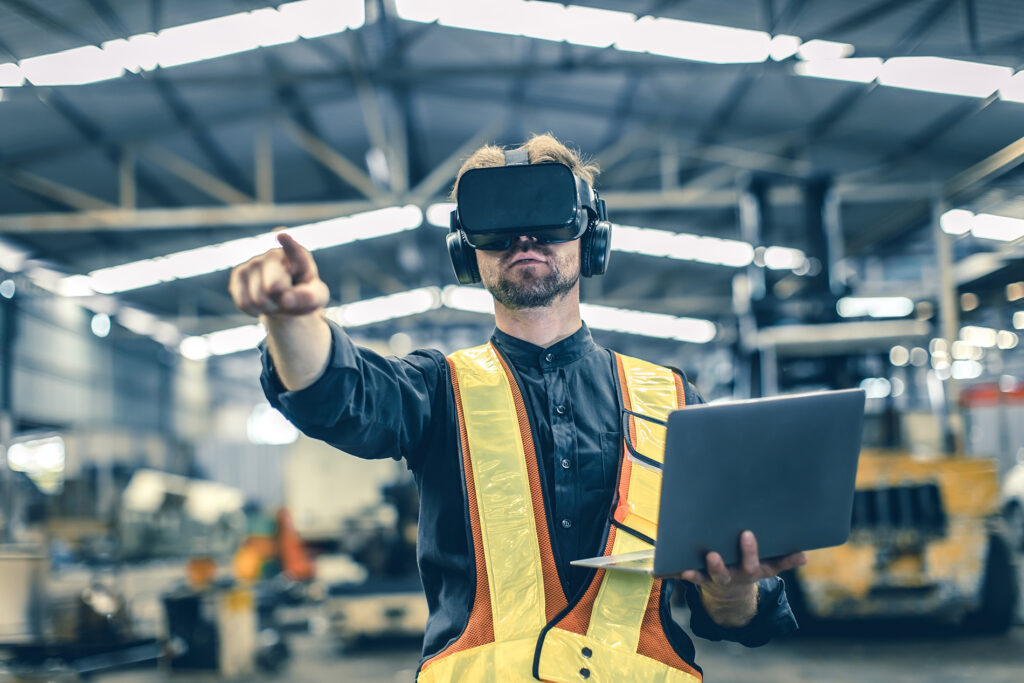
By analysing large data sets, AI has a significant impact on the pace and relevance of decisions. And this makes construction processes more precise and less prone to human error. High-tech robots and the automation of construction processes make it possible to reduce the number of manual workers on site, while increasing productivity.
Application of AI in design and construction planning
One of the most important areas at the moment, where AI is a more and more commonly used resource, is in the design phase. Thanks to the use of advanced AI algorithms in construction management, artificial intelligence can today support the work of designers and constructors by helping them with complex calculations or complex analyses that used to require whole teams of engineers. Of course, this collaboration is only just beginning, and artificial intelligence engaged in creating structural designs on its own remains out of the question, for the time being. Nevertheless, this is certainly a direction to follow for the design of industrial facilities and more.
A current example of how AI is used for design is BIM (Building Information Modelling) technology, which provides a contemporary digital alternative to information processes previously based on hard copy documentation. BIM enables the creation of virtual three-dimensional models (these are the so-called digital twins in architecture) that integrate key information about a building, its geometry, materials used, technical parameters and costs. This form enables effective collaboration between all participants in the investment process at both the design and implementation stages.
Additionally, in the planning phase, AI supports the process of optimising the use of resources – both human-related, machines (including predictive models) and materials. This allows us to determine the lead time and final costs with much greater precision.
Construction site automation: robots and AI-driven machines
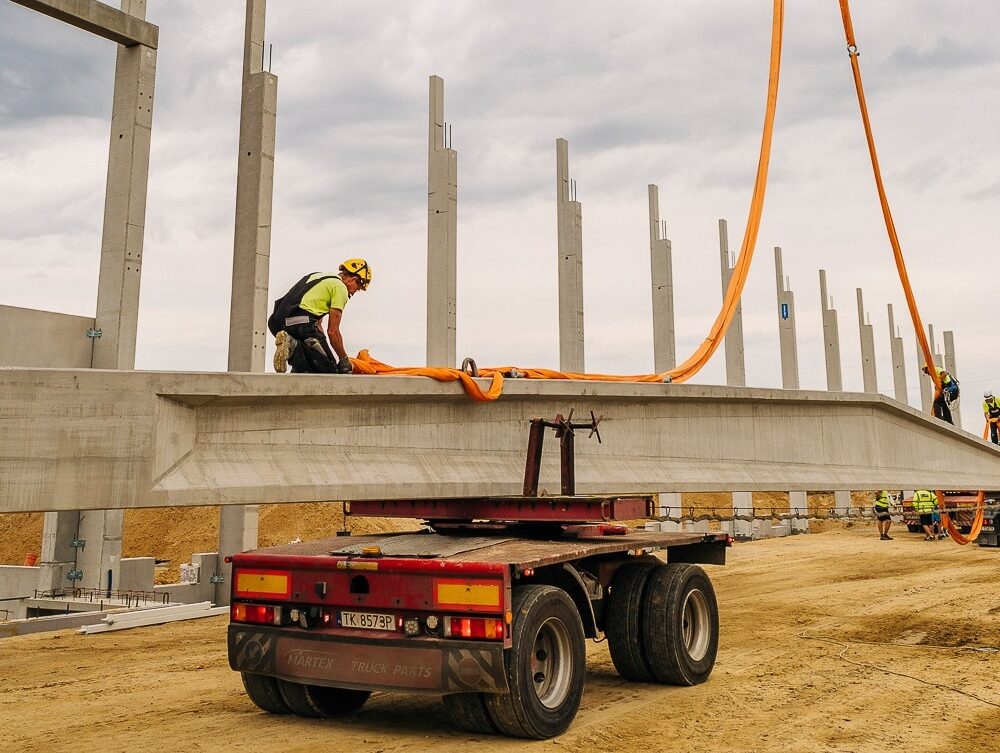
Artificial intelligence on the construction site is one of the most anticipated trends in modern construction, when considering human resources management. The construction industry has always been regarded as dangerous due to frequent works at heights and the need to use heavy equipment. This is why the reality where robots are replacing humans during the most hazardous activities, minimising the risk of accidents as they do, is a dream come true for employers who have long been facing shortages of skilled workers such as concrete workers, reinforcing-bar setters and structural fitters. Already today, robotic machines and automatic systems are entering construction sites, albeit on a small scale and rather in a test form for the time being, to perform work with a precision and speed that no human could achieve. Importantly, the machines never get tired, and they do not require eight-hour working day. So, they can lay bricks, pour concrete or take part in the assembly of pre-engineered components for many hours. Robots and the automation of construction processes make it possible to adapt their work to changing site conditions, minimising errors.
AI in cost and safety management
Increasing safety on the construction site has already been mentioned in the previous paragraph, where the prospect of replacing humans with robots when carrying out dangerous work was discussed. But artificial intelligence on the construction site is already helping in other ways. As a matter of fact, before robotic machines come into common use, special hard hats, the so-called SmartHats, can already ensure the safety of workers. On the one hand, they can monitor workers’ vital signs in real time, reporting, for example, on signs of fatigue and the resulting risks. On the other hand, they can be fitted with cameras that continuously transmit images from the construction site to the inspectors, who can thus notice faults, such as missing harnesses when work is done on the roof, or the entry of an unauthorised worker into the dangerous area of the machinery operation.
Cost management is one of the key components of any construction project. Intelligent systems in the construction industry make it possible to accurately track material prices and analyse their variability over time. They can also anticipate changes in labour costs and this way are able to identify potential savings. By applying predictive analytics to construction, AI systems can predict when and where unforeseen expenses or schedule delays might ensue. This kind of foresight allows to respond more swiftly, and reduces the risk of exceeding the budget or delaying the completion date.
Sustainable construction through AI
Sustainability is one of the most important aspects of modern construction. According to the European Commission, all buildings, from their construction, to use, to renovation and demolition, account for around 40% of energy consumption and the production of 36% of greenhouse gases across the EU. In this context, AI plays a key role in helping to design energy-efficient facilities that cut down on the consumption of natural resources. By analysing large data sets, artificial intelligence can assist in the most favourable selection of materials, as well as optimise energy distribution in buildings and select heating or lighting systems accordingly. But AI’s function is not limited by the construction completion date.
AI in construction also helps to monitor energy consumption during the life of a building, enabling early detection of inefficiencies and offering solutions to improve energy efficiency. Automated building management systems that use AI algorithms can adapt internal conditions in real time to the changing needs of occupants, while reducing energy consumption.
The future of AI in industrial construction: what lies ahead?
The future of AI in industrial construction is definitely bright. Every year, the technology will become more developed and its use will become more widespread. With the development of artificial intelligence, we can expect further automation of construction processes, which will reduce the cost and time consumption of projects. However, this raises a question that is already on the lips of professionals in other industries: can AI and robots replace humans on the construction site and is our role under threat?
This is not something we need to worry about for the time being. Artificial intelligence is still in the early stages of implementation in the construction industry, and we should see it as a partner in decision-making, not a threat. We can observe the new construction reality being shaped before our eyes. Companies that are already investing in the development of intelligent building systems are set to gain a competitive advantage and be ready for future challenges much sooner. And after all, this is only the beginning!