

Modern industrial construction – and similarly the design sector as a whole – is an area undergoing rapid technological change. In making the transition from traditional working methods to digital ones, the construction industry has become one of the main beneficiaries of innovative IT solutions. These no longer merely support the design processes themselves, but revolutionise the way data is managed, providing the foundation for business continuity.
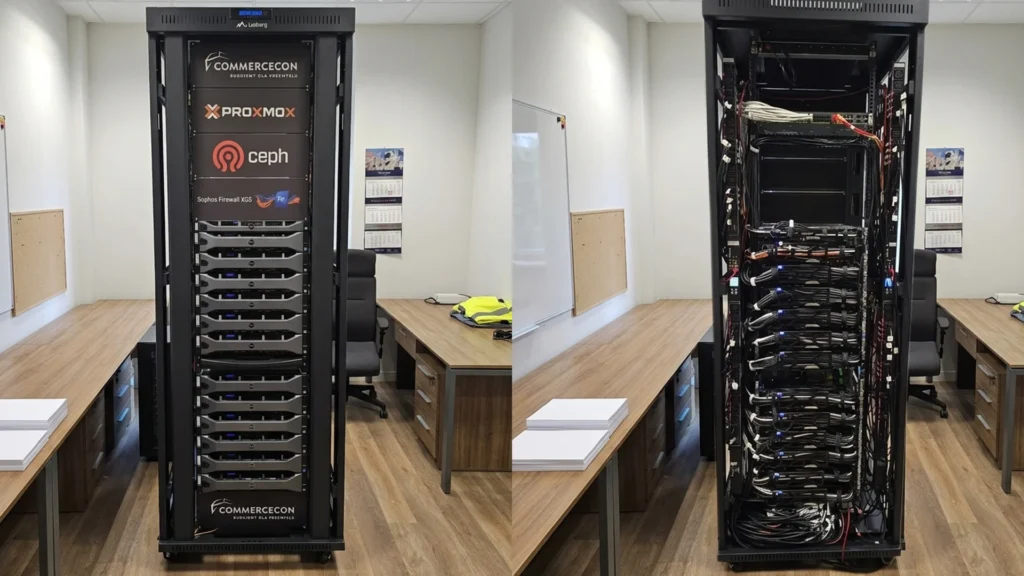
Hyper-converged infrastructure (HCI) is becoming an invaluable tool in the construction industry. It serves as the basis for the implementation of modern systems, including artificial intelligence-based tools. What is the point of introducing solutions that generate huge amounts of data if you do not provide a proper architecture that is resilient to failures and data loss? This is why, at Commercecon, we began our digital transformation by laying the technological foundations.
The construction industry is changing before our very eyes
Many engineering practitioners can still remember the days when designers and architects used drawing boards and the world of construction was entirely analogue. The breakthrough came in the 1980s with the introduction of CAD (Computer-Aided Design) software. Software programmes such as AutoCAD and CATIA gradually revolutionised the market, although their availability was initially limited by the high cost of the hardware.
The real revolution of the 1990s brought about the large-scale computerisation of design offices. Tasks that used to take months have now been automated. The last decade, in turn, has seen rapid development in BIM (Building Information Modelling) technology. Building Information Modelling enables us to manage a digital 3D model throughout the entire life cycle of a building – from planning, to construction, to operation. Today, advances in artificial intelligence are helping to optimise costs and improve safety on construction sites, while robotic machines are assisting workers.
However, this digitalisation presents companies with a huge challenge: how can they ensure data availability and durability in a perpetually operating system? How can you ensure the security of stored data and protect it against loss? HCI is precisely the answer.
What is Hyper-Converged Infrastructure? (An expert’s perspective)
Hyper-converged infrastructure combines computing, storage and networking resources into a single, integrated software-defined unit. From an IT engineer’s point of view, three parameters are key here:
- Scalability: HCI allows resources (computing power and storage) to be scaled up freely without any rigid restrictions. If a project suddenly requires more power, you simply add another node, and the system integrates it automatically.
- Flexibility: This involves the intelligent allocation of the necessary resources precisely where they are needed by the business at any given moment (for example, shifting computing power to render a BIM model at night).
- System redundancy: HCI architecture eliminates so-called single points of failure (SPOFs). Redundancy ensures that the functions of a failed physical component or an entire server are automatically taken over by the remaining resources in the cluster. This helps maintain business continuity, and prevents company operations grinding to a halt due to hardware failures.
AI in the construction industry – support built on a solid foundation
The use of AI in the construction industry is becoming increasingly important in precise visualisations and analyses. However, a stable infrastructure is essential for AI to process vast amounts of data in real time. At Commercecon, we know that AI without HCI is like a fast car without a solid chassis – the system must be resilient to load fluctuations and hardware failures.
Data security – protection against losses and failures
Data security is a priority for general contractors. However, we need to clarify the terms: in the context of HCI, security primarily means minimising the risk of data loss. Conventional infrastructure based on servers and disk arrays often had what we refer to as ‘single points of failure’.
HCI is significantly changing this situation with:
- High resilience to failure: With the solution’s redundancy, the system is able to ‘survive’ a physical server failure without affecting the engineers’ work.
- Minimal downtime: In the event of a failure, automatic replication mechanisms ensure that the time taken to restore full functionality is virtually imperceptible to the end user.
- A distributed system: Data in HCI systems is not stored in a single physical location on the disk. They are distributed and replicated across various nodes. This architecture not only protects against the consequences of disk failures, but also helps safeguard against successful cyber-attacks.
Reality versus legal requirements and work continuity
Data protection in the construction industry also involves compliance with standards. HCI systems offer built-in audit functions that monitor the use of information. However, it is redundancy and work continuity that allow us to rest easy when it comes to the regulations governing liability for design data. Thanks to the advanced backup and replication mechanisms within the HCI, data remains secure regardless of any technical incidents.
A competitive advantage through modern solutions
At Commercecon, we gain a real competitive advantage by utilising Hyper-Converged Infrastructure. We can manage IT resources securely and flexibly, as we optimise the costs of storing large BIM files. The integration of HCI with open-source technologies gives us considerable flexibility in adapting the environment to the specific, ever-changing requirements of each construction site.
For us, the introduction of Hyper-Converged Infrastructure is not only a step towards modernity, but, primarily, a way of ensuring operational continuity more effectively. Thanks to this, we minimise the risk of IT faults that could disrupt construction processes. This technology sets new standards in data management, and we at Commercecon have successfully implemented it.