A steel industrial building is the ideal solution when the project owner wants a durable manufacturing, commercial or storage facility and a fast construction process. But a seemingly simple steel structure requires careful design and precision during the execution work. We have prepared a complete guide that shows the steel hall construction process step-by-step from the general contractor’s point of view, from site assessment, design, and drafting of the necessary documentation, to manufacture and erection of the structure, through to acceptance tests.
How is the steel industrial building built?
The construction of a steel industrial building is a complex, multi-stage process that requires precise planning and close collaboration between specialists from different disciplines. From soil analysis and site preparation, to structural design and pre-engineering of the building, to the installation of the steel structures and finishing works, each stage is crucial to ensuring the durability, safety and functionality of the facility.
The success of such a project depends to a large extent on the project contractor, whether it has experience in such projects, whether it has the right equipment and crew, and whether it can offer comprehensive services and take on the burden and responsibility for the entire industrial building investment. Commerecon is such a partner, which is why seeking advice from our experts and using our many years of experience in steel industrial building construction is worthwhile in order to avoid mistakes, optimise construction costs and work to the agreed schedule.
Concept planning and preparation
Any process of building an industrial facility should begin with an analysis of the project owner’s needs, which will determine the exact function of the building and its purpose. This information will directly influence all parameters, such as the usable floor area, height, floor load-bearing capacity or required fire load and specialised installations. At this stage, we also need to determine the budget, which will allow us to propose optimal solutions, also financially, and the time in which the project is to be completed, which in turn will translate into a work schedule and decide whether the investment in the industrial building will be successful or not.
Assuming that the project owner already has the ownership title for the site, the first thing to do is to check local ground conditions, that is, soil bearing capacity, groundwater table, ground water conditions, road access, and utilities. At this stage, it is important to recognise any defects in the ground, which can significantly extend the site preparation process and increase the cost of this work, and in extreme cases, even prevent further construction. The nature of the planned project in the chosen location must be in accordance with the local development plan or the obtained zoning approval.
On this basis, we prepare a conceptual design, which involves determining the structural layout of the building, dimensions, pier arrangement, type of steel structure (single-bay, multi-bay), deciding on roof cladding and wall cladding, and determining special requirements, such as the requirement for special ventilation systems, overhead cranes or the construction of a cold store.
Design and permits phase
If the conceptual design presented by us is accepted by the project owner, we proceed to draw up a building plan and specifications, in accordance with the Polish construction law, and detailed plans for construction and shop drawings and specifications, which are of critical importance for the smooth assembly of the steel structures.
We select all materials and technological systems, that is, we determine the grade of structural steel to be used, the type of roof and wall sheathing, thermal insulation systems, window and door frames, and building facilities (electrical, fire, sanitary, air conditioning, ventilation, type of flooring).
At this stage, we prepare the necessary documentation, which we submit with the planning application. The documentation is usually very extensive and includes: the zoning approval or a copy of registration records and map extract from the local spatial development plan, building plans and specifications, site development plan, topographic survey map, service connection requirements (electricity, water, sewage), extract from the land and building register, as well as additional formal and legal documents in accordance with the given project, that is, consent for water engineering works, environmental consent decision, clearing permit, etc.
Site preparation, earthworks and foundations
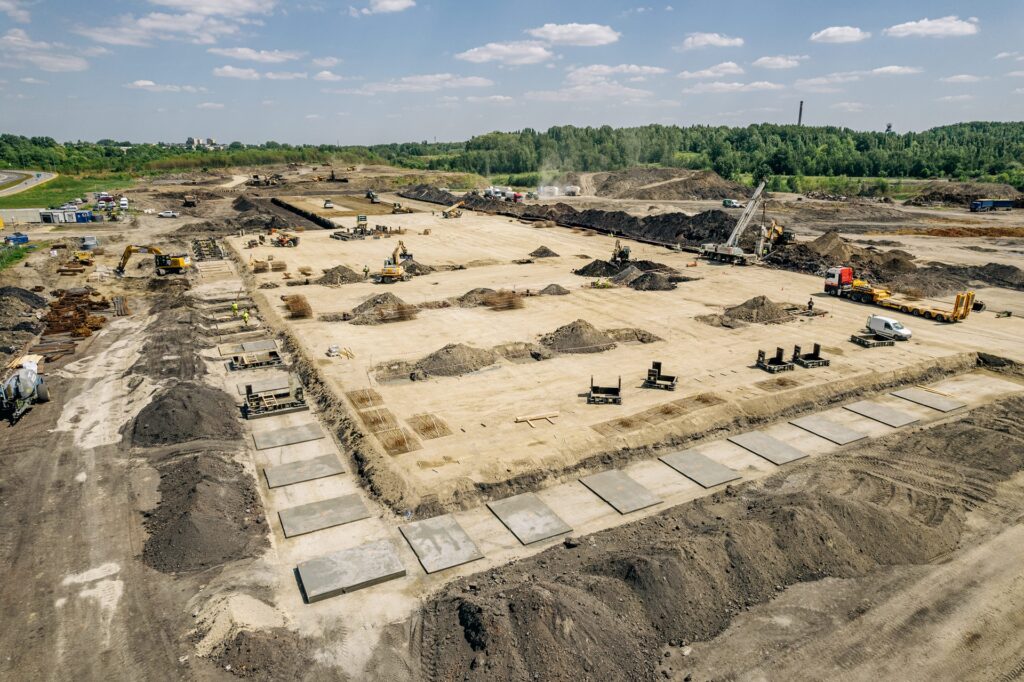
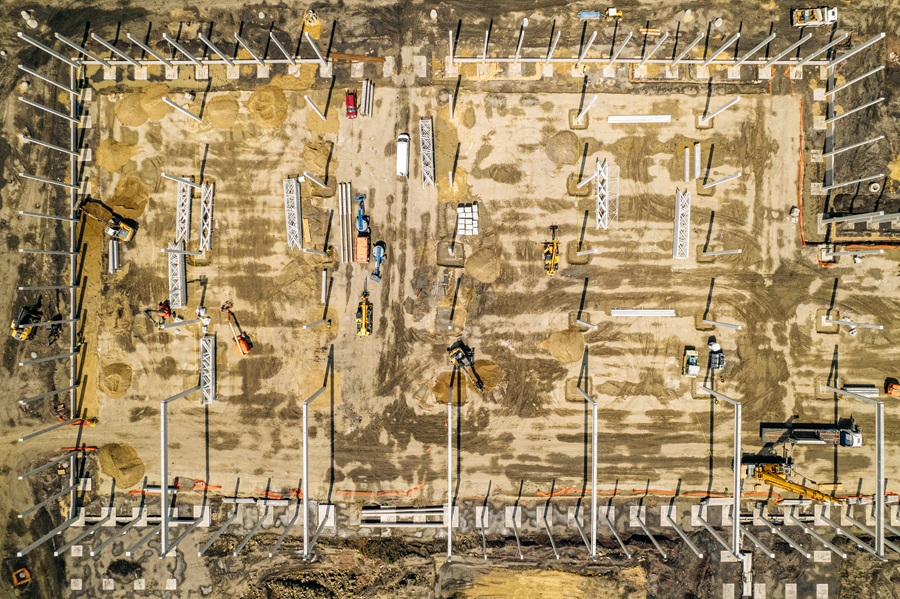
Work on the site begins with site set up. The following must be provided: fencing, access roads and a yard for heavy equipment, welfare facilities for workers, as well as a warehouse where pre-engineered steel and other materials will be stored.
The schedule for the construction of a steel industrial building always opens with earthworks to level the site, drain it, stabilise the ground and, if necessary, replace soil layers or harden the underlying soil. We can say that this is a critical stage, because any mistakes made here can significantly affect not only the comfort of future use of the building, but, above all, safety.
Prawidło przygotowany grunt pozwala przystąpić do wykonania fundamentów, które są jednym z kluczowych elementów konstrukcyjnych hal przemysłowych. PozostająAfter preparing the ground properly, you can construct the foundations which are one of the key structural components of industrial buildings. Having direct contact with the ground, they are responsible for transferring loads to it from higher parts of the building to ensure its stability. The type and shape of the foundations depend on several factors, including the aforementioned soil properties, the size of the building, but also the type of the built feature.
Ideally, isolated spot foundations, the so-called footings, should be built under each pier individually for buildings with a steel load bearing system and slender construction when considering functional and economic aspects. They can be made in monolithic technology on site, which involves a lower construction cost, but also the need for cure time after concrete pouring (about 28 days, after which the concrete gains full strength), or with pre-engineered concrete products made in a factory. This is a more expensive method, but a better one by far, when lead times are limited.
Steel building – pre-engineered of steel components
Pre-engineering is another important and, in a sense, unique stage associated with the assembly of a steel building. Why unique? Because it is not directly under the responsibility of the general contractor. Yes, structural components are prepared following the documentation prepared by the general contractor, but they are usually manufactured by an independent manufacturer.
The following is crucial to consider at the building pre-engineering stage:
- Attention to the quality of the drawing documentation, including the precise positioning of openings (drawing errors, collisions, missing or incorrect positioning of openings will result in additional on-site work)
- Attention to workmanship (in particular dimensioning and tolerances)
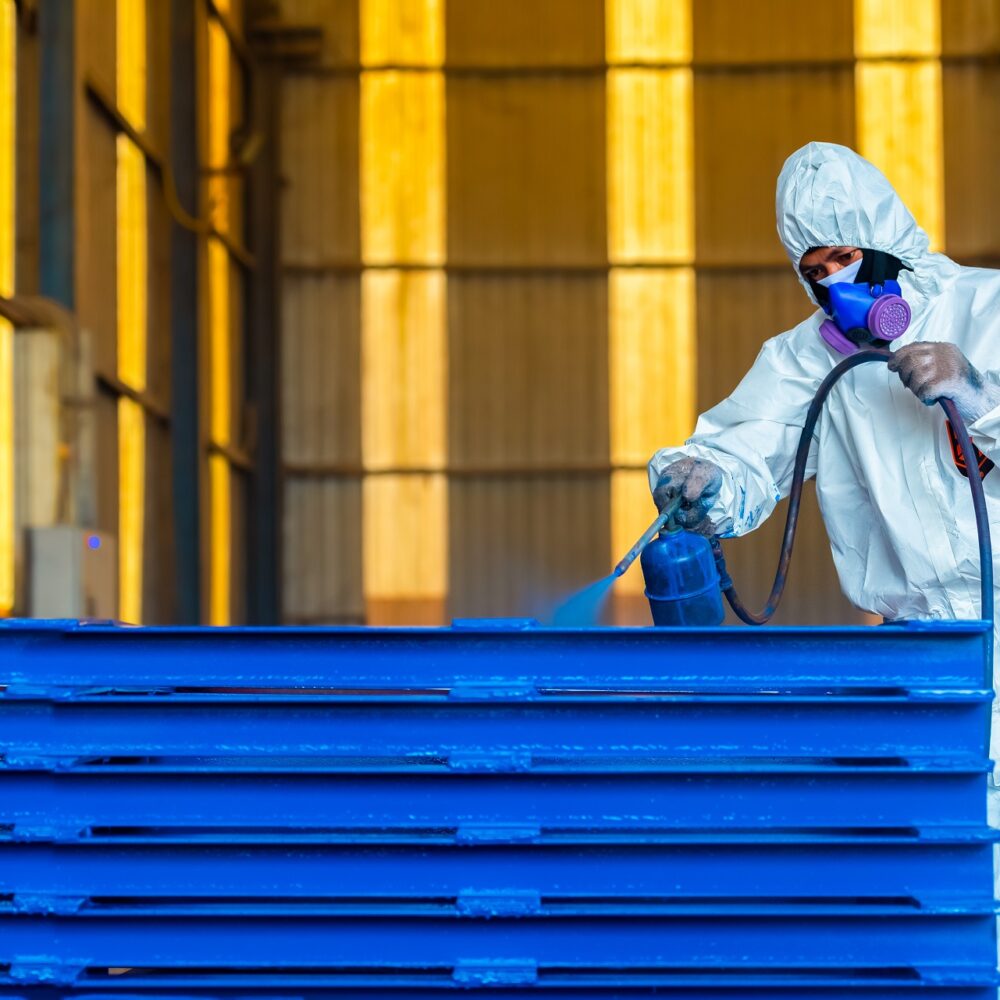
- Corrosion protection (e.g. galvanising, powder coating or other protective coatings)
- Control of compliance with execution standards (for steel structures, these are standards for materials, welds, structural steel, for example).
Well-designed and pre-engineered components arrive on site ready for assembly, which reduces the amount of ancillary work and minimises the risk of assembly errors, allowing the work schedule to be maintained.
Assembly of steel structures and finishing of the building
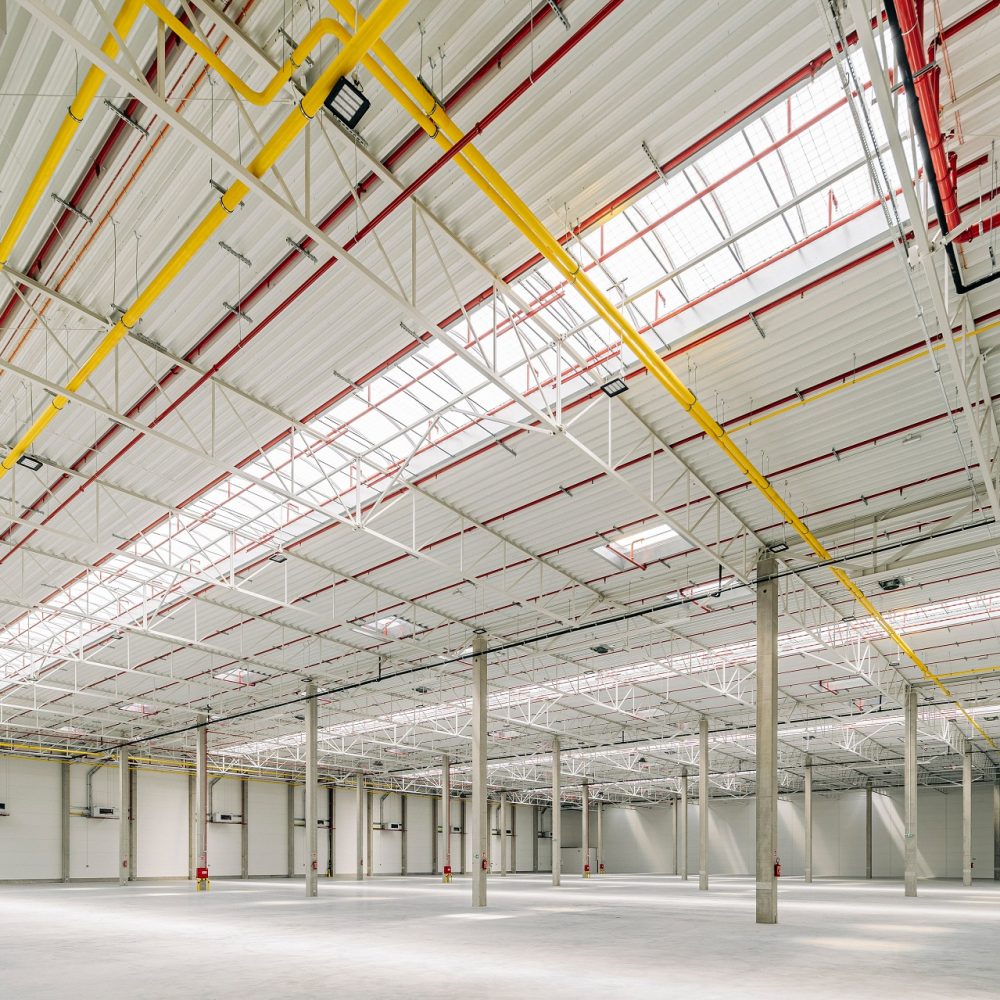
With regard to their role in the structure, the components of a steel building can be conventionally divided into two groups: primary steelwork (piers and main girders) and secondary steelwork (purlins, bracing, gable wall piers, lintel structure). They are one by one assembled in accordance with the assembly plan and the working drawings (the components must fit into place according to the markings and openings).
Once the structural steel frame is in place, we proceed with the assembly of the cladding for the roof and the side walls. Lighter cladding (sheet metal) is used in unheated industrial buildings, while sandwich panels or other insulation systems are used in those that require temperature maintenance. When constructing the cladding, you must consider the installation of skylights, windows, smoke vents or lighting hatches, doors and gates, which require subsequent flashing.
The next step involves the installation of services – electrical, sanitary, plumbing, heating, air conditioning or ventilation, fire protection systems and lighting. If the facility has specific process requirements, such as cold storage, it needs specialised systems to be installed.
Simultaneously with the installation of the services, work can already be done on the industrial flooring, which must be adapted to the load planned for the building. Load is not meant to be the planned type of on-site handling only, but also the movement of machinery and other heavy vehicles. Final framing, flashing or painting is also carried out. By this time, work not directly related to the assembly of the steel building will have usually started: the area around the building is developed by providing paved paths, access roads, vehicle circulation areas and fencing.
Commissioning
At the final stage of steel building construction, a commissioning is carried out to confirm that the building has been constructed in accordance with the design, applicable standards and building regulations. The quality of the work, the completeness of the as-built documentation and the compliance of the building with the conditions of the building permit are reviewed. At this stage, the authorities of the State Sanitary Inspectorate and the State Fire Brigade are notified mandatorily.
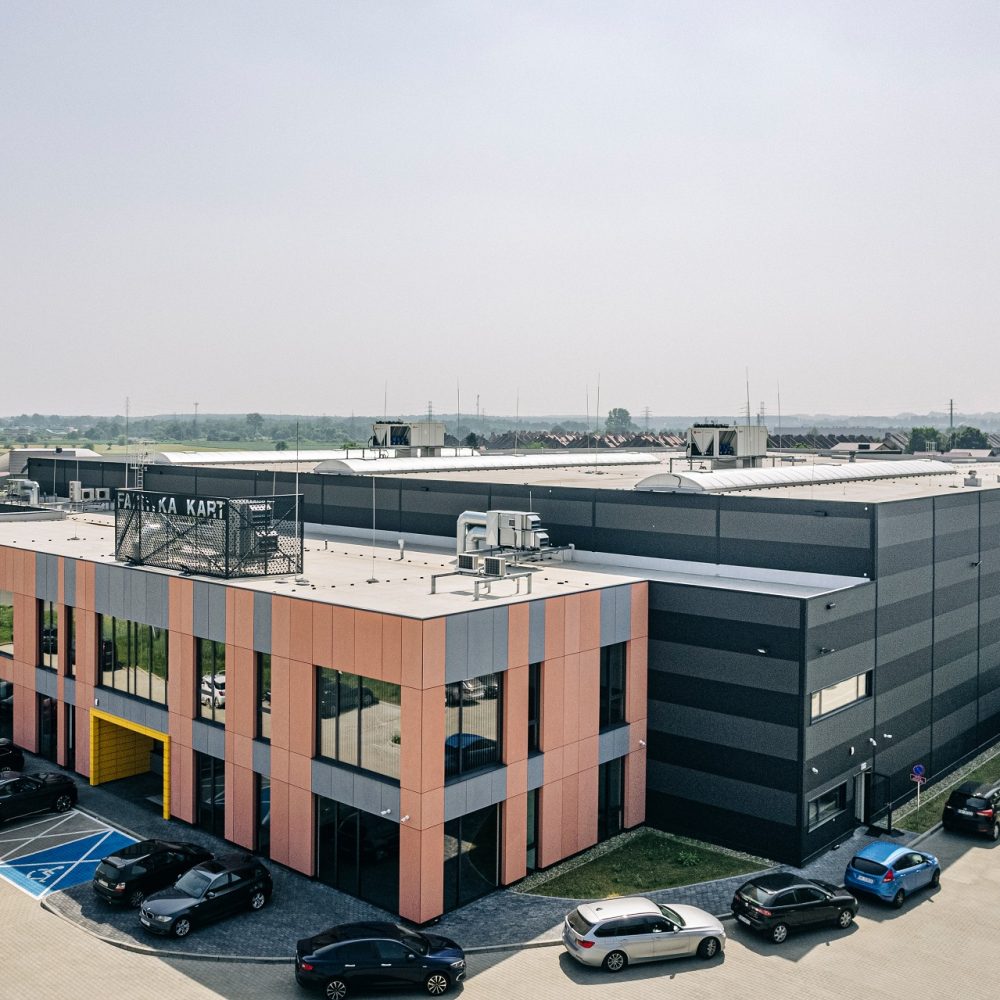
Only passing the acceptance tests at commissioning without any comments from the above-mentioned authorities allows you to apply for an operating certificate. In practice, this means that the industrial building project can be considered completed and the facility can be handed over to the project owner for operation only after it is approved formally.
Q&A – Project owners’ most frequent questions:
Is it mandatory to inspect the ground conditions of the site?
- It is not, but we strongly recommend it. A site intended for the construction of an industrial building can conceal many defects we cannot spot with the naked eye, and which can significantly delay the entire site preparation process, as well as incur additional costs that owners are unaware of. Moreover, in extreme cases, ground collisions can even make construction impossible.
Is it the project owner or the general contractor that applies for the planning permission?
- The application can be submitted by either party. However, due to the time-consuming and complicated procedure, we recommend entrusting this task to the general contractor for the project. It is up to date with current legal regulations (many project owners can get lost in the maze of legal and administrative complexities), and will ensure that the documentation is prepared in accordance with all requirements.
What type of foundation is usually used for steel industrial buildings?
- ZBecause the structural steelwork of the steel building provides support for the roof at a fairly wide pier span, building spot foundations or footings under each pier individually is the most justified approach. This type of foundation is also called a spot footing
What does the construction of industrial floors depend on?
- Choosing the right floor for an industrial building depends on several factors. These primarily include the expected load, which means the type of on-site handling, but also the type and movement of machinery. When selecting the floor, the effects of moisture and various chemicals must also be taken into account, as well as the need to cope with very high or low temperatures, as in the case of a cold store or deep freeze store.
How long does is take to obtain a use permit for a building from the time the necessary documents are submitted?
- This is usually around three to five weeks, with the assumption that all required procedures will run smoothly. Here, it is worth relying on the experience of the general contractor as well, because it has worked with the relevant authorities for years and will take due care to prepare the necessary documentation.